
Tennis

Grass tennis courts

Tennis

Fineturf has constructed grass tennis courts at some of the UK's top venues such as Wimbledon, Devonshire Park and Nottingham Tennis Centre. We build and renovate natural grass courts at a national and local LTA club level and for private individuals. Very few companies in the UK have our expertise and experience .

Overview

What you need to know.

Specification
LTA and Sport England grass-court construction
Orientation
New courts ideally north to south, not east to west
Loam
Low-clay tennis loam for deep roots and quick recovery
Steam
85°C in the top 65mm for one hour, used at Wimbledon

Recent and notable workAELTC Wimbledon · The Queen’s Club · Devonshire Park · Nottingham Tennis Centre · AELTC Raynes Park

Construction profile

Drainage, loam, then the sward.

Fineturf has constructed grass tennis courts at Wimbledon, Devonshire Park and Nottingham Tennis Centre, as well as national and local LTA clubs and private courts. New courts are ideally oriented north to south so players are not looking into the sun. An uneven formation leads to mismatched depths in the first loam layer and uneven bounce. Tennis loam with low clay content supports a deep-rooted sward that recovers quickly from wear.

  • Excavate the court formation and laser-level the surface
  • Drainage, irrigation advice and gravel carpet
  • Laser-level and consolidate each loam layer so layers key together
  • Final tilth, fertiliser and grass seed specification
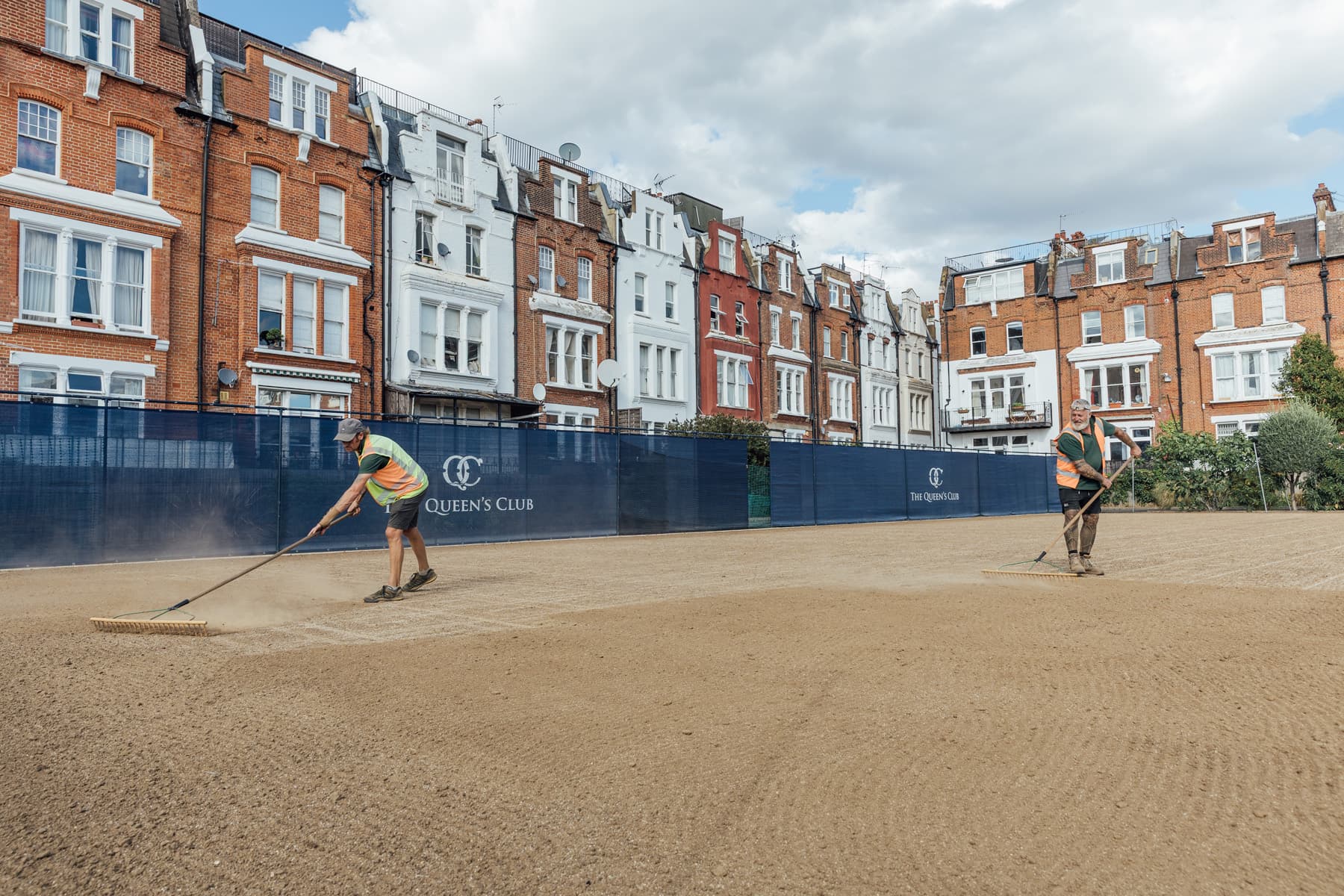
The surface influences ball bounce and how players move. Grass is the fastest court and the best suited to serve-and-volley play. It is also natural, renewable and glare-free.

Fencing keeps the ball in play, secures the court and preserves visibility into and out of the compound. We specify and supply tennis court fencing, net posts, windbreaks and mowing strips.

Fineturf’s custom-built steam unit sits beside the court; heatproof covers retain steam. The target is 85°C in the top 65mm of the profile for a full hour, and 60°C below that, reducing weeds, pests and disease without chemicals. After the 2024 Wimbledon Championships we sterilised nine AELTC grass courts including Centre Court and Court One, as a rolling programme so courts can stay open longer for members. The same process has been used on Queen’s Club Centre Court.

Steam surface sterilisation

Fineturf has constructed grass tennis courts at Wimbledon, Devonshire Park and Nottingham Tennis Centre, as well as national and local LTA clubs and private courts. New courts are ideally oriented north to south so players are not looking into the sun. An uneven formation leads to mismatched depths in the first loam layer and uneven bounce. Tennis loam with low clay content supports a deep-rooted sward that recovers quickly from wear.

  • Excavate the court formation and laser-level the surface
  • Drainage, irrigation advice and gravel carpet
  • Laser-level and consolidate each loam layer so layers key together
  • Final tilth, fertiliser and grass seed specification
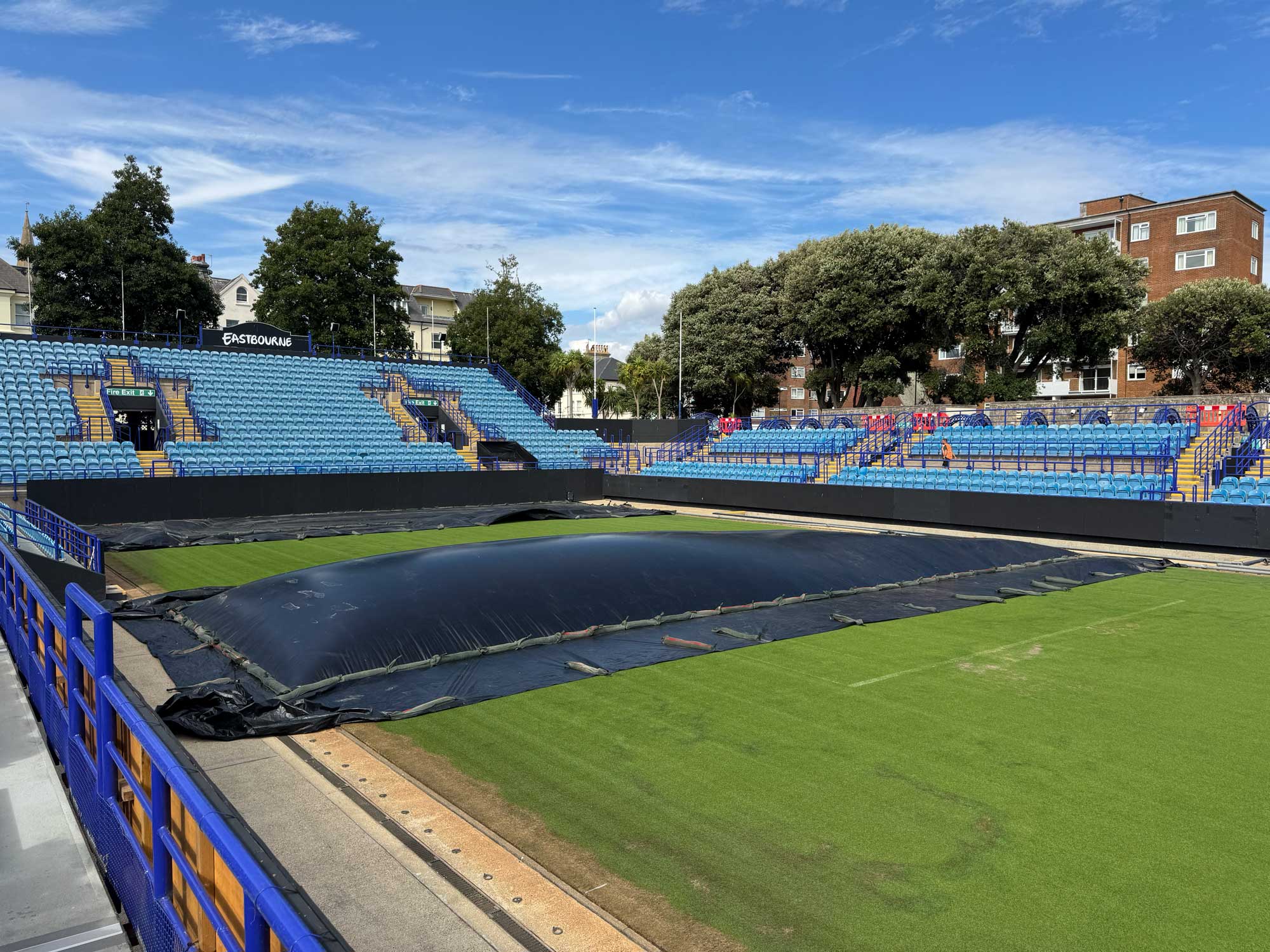
The surface influences ball bounce and how players move. Grass is the fastest court and the best suited to serve and volley play. It is also natural, renewable and glare-free.

Fencing keeps the ball in play, secures the court and preserves visibility into and out of the compound. We specify and supply tennis court fencing, net posts, windbreaks and mowing strips.

Fineturf’s custom-built steam unit sits beside the court; heatproof covers retain steam. The target is 85°C in the top 65mm of the profile for a full hour, and 60°C below that, reducing weeds, pests and disease without chemicals. After the 2024 Wimbledon Championships we sterilised nine AELTC grass courts including Centre Court and Court One, as a rolling programme so courts can stay open longer for members. The same process has been used on Queen’s Club Centre Court.

Steam surface sterilisation

Process

How we deliver the work.

  1. Excavation for court formation

    Subsoil is excavated and the surface laser-levelled for consistent loam depth and performance.

  2. Drainage, irrigation and gravel carpet

    Effective drainage ensures consistent moisture levels. We advise on irrigation design and installation.

  3. Level, consolidate and key

    Each loam layer is laser-levelled and consolidated. Tennis loam with low clay content supports a deep-rooted, high-performance sward.

  4. Prepare final surface and seed

    The final tilth is prepared, fertiliser applied and grass seed sown, with fencing, net posts and mowing strips available.

Enquire

Talk to our team about tennis.